


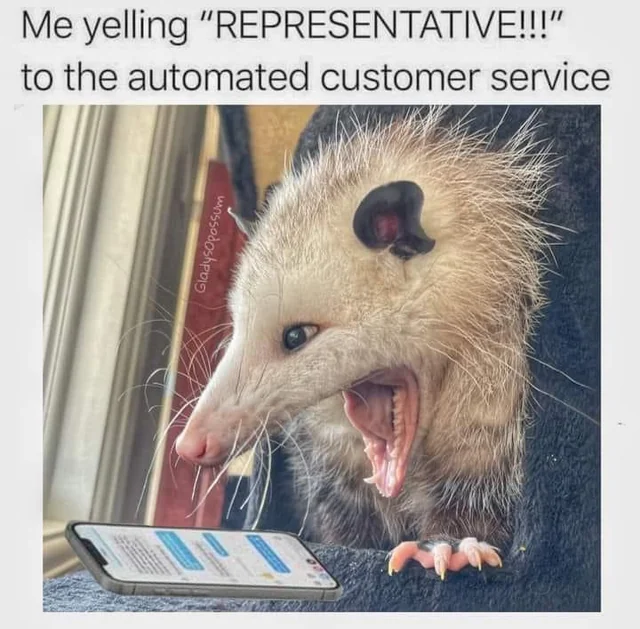
Most of us have experienced the frustration of needing to speak with an actual human customer service representative but first having to jump through a series of hoops just to reach one. I’ve even had the especially unpleasant experience of not being able to reach a person at all.
By the end of the interaction, I wasn’t just frustrated. I was a little angry and questioning whether I wanted to continue being a customer. If you haven’t run into this scenario yet, count yourself lucky!
That said, I’ve also had AI agents help me solve an issue or find the information I needed far faster than it would have taken to reach a living, breathing customer service representative. When the request is straightforward and the technology works as intended, AI can make customer service better.
That is the sweet spot organizations need to find. AI should shorten the customer’s path to resolution, not lengthen their path to a human.
So, how do you decide which customer requests AI should handle, when a person needs to step in, and how to design that handoff without leaving customers feeling trapped?
Where AI Works Well in Customer Service
AI can be genuinely useful in customer service. The key is giving it the right job. It performs best when a request is routine, the possible outcomes are reasonably predictable, and the information needed to respond is accurate and accessible. Checking an order status? Great. Resetting a password? No problem. Resolving a complicated billing dispute involving three departments and an exception to company policy? Move over robot, I need to speak to a human.
1. Routine questions and self-service requests
AI gets high customer approval for requests customers frequently want to handle themselves:
- Checking an order or refund status
- Confirming store hours or product availability
- Scheduling an appointment
- Updating basic account information
- Making a payment
- Resetting a password
- Finding the correct policy or instructions
This isn’t just a cost-saving opportunity. Customers often prefer self-service when it works. I know I do. A 2026 ServiceNow and ThoughtLab study of more than 34,000 people found that 75% of customers prefer to try self-service before calling a representative.
However, the same research found that 46% believe current chatbots do not understand their questions and concerns. That fact can’t be ignored. Customers are open to AI, but their patience disappears quickly when it can’t understand the request or provide an exit. ServiceNow’s 2026 CX study.
2. Helping customers bypass menus and get to the right place
AI can also improve customer service without attempting to resolve every issue itself.
Take this example from Home Depot. During a 50-store pilot, its AI voice agents reportedly identified why a customer was calling within 10 seconds and moved callers toward a solution four times faster than its traditional phone menus. It can take forever to find what you need through a phone menu. The system can answer common questions and initiate certain actions, but customers are always offered a direct path to a human associate.
The last part, a direct path to a human, matters. The AI is being used to remove the “Press 1, press 4, press 2—and then repeat everything” experience, not to build a taller wall between customers and employees. The Home Depot’s pilot results.
3. Completing well-defined transactions
The most useful AI agents do more than retrieve an FAQ. They complete a task.
Air India recently expanded its use of AI for refund processing, passenger name corrections, email resolution, and employee knowledge support. The airline reports that automation reduced refund turnaround time from approximately 14 days to four hours. It also shortened name-correction processing from three days to about 30 minutes. Both are huge wins for customers!
These are company-reported results rather than independently verified findings, but they demonstrate an important point: AI creates more value when it can safely carry out a defined process, not merely tell the customer which form to find. Air India also says these actions operate within established guardrails, with human oversight retained where appropriate. Air India implementation coverage.
4. Giving customers proactive, personalized information
AI can also provide information before a customer has to ask for it.
Bank of America reports that its Erica virtual assistant has handled more than three billion customer interactions since launching in 2018. It can provide balance insights, identify cash-back offers, answer account questions, and schedule appointments that hand customers off to higher-touch service channels.
Bank of America says more than 98% of Erica users find the information they need. Again, these are the company’s own figures, but another detail may be more educational: Erica uses a controlled library of more than 700 responses and has undergone over 75,000 updates. 75,000!
In other words, a successful AI service tool is not something an organization switches on and then forgets about. It requires clear boundaries, reliable data, ongoing maintenance, and intentional handoffs. Bank of America’s Erica results.
What do these examples have in common? The customer’s intent can be identified, the information comes from trusted systems, and the range of appropriate actions is reasonably well defined. AI is not being asked to improvise its way through an emotionally charged or highly unusual situation.
That is where the line should be drawn and where human judgment becomes much more important.
When Customer Service Needs a Human
AI becomes less suitable as the complexity, emotional weight, and potential consequences of a customer’s situation increase. Providing the wrong store hours is inconvenient. Giving incorrect guidance about a disputed bill, refund, debt, or other high-stakes matter can cause real harm.
A useful rule is this: The greater the consequences of being wrong, the easier and earlier the path to a human should be.
That does not mean every complicated request must begin with a customer service representative. AI can still gather information, summarize the issue, or route the customer to the right person. But it should recognize when it has reached the limits of what it can safely or appropriately handle and allow the customer to move forward without another round of digital hoop-jumping. I repeat – without digital hoop-jumping.

Sometimes AI needs to hand the conversation to a person because it cannot resolve the request. Other times, AI may be perfectly capable of finding an answer but the customer would still feel better speaking with another human being.
Those are two different needs, and both matter.
I recently needed to switch pharmacies for a prescription. I called the new pharmacy because I wanted to make sure I understood the process, had provided everything necessary, and could receive the medication as quickly as possible.
The automated agent collected the details of my request and told me that I would need to complete a form or contact my doctor to change the pharmacy. Then the call ended. There was no option to speak with a person.
Shortly afterward, I received a text message containing a link to the form, which is something the AI had not explained would happen. In the end, the prescription was successfully transferred and filled at the new pharmacy.
If we measure that interaction only by whether my request was resolved, the automation worked.
But that does not tell the whole story.
I called because I wanted reassurance that I understood the process and had everything set up correctly. Instead, the call ended before I could verify what would happen next or ask any follow-up questions. The prescription was handled, but my need for confidence and clarity was not.
1. Resolution Is Not the Only Measure of Good Service
This is where customer service metrics can become misleading. A company may count an interaction as successfully “contained” because the customer did not reach a representative. It may count the request as resolved because the correct form was eventually submitted.
Neither measurement captures how the customer felt during the experience.
Did the customer understand the next step? Did they feel confident that the issue was being handled? Were they given a choice? Did the interaction strengthen their trust in the company or simply accomplish the minimum required task?
A 2026 Gartner survey of 3,566 B2B and B2C customers illustrates this tension well. Half of the respondents said customer service interactions are easier when companies use generative AI. At the same time, 87% said it is essential that companies provide an option to reach a human representative.
Customers are not necessarily rejecting AI. They are rejecting the loss of choice.
There are also situations where reassurance, empathy, and human accountability are part of the resolution. An AI agent can recognize language associated with concern and generate a sympathetic response. But it does not experience concern. A human representative may still misunderstand the situation, of course, but that person can ask an unexpected follow-up question, hear hesitation in someone’s voice, exercise judgment, and take responsibility for what happens next.
That difference matters when the customer is worried about medication, fraud, debt, a family emergency, a service interruption, or another issue that feels personal or consequential.
2. Know When AI Should Step Aside
A human representative should become readily available when:
- The customer asks to speak with a person.
- The request does not fit a standard process.
- The customer has already repeated or rephrased the question.
- The available information is missing, contradictory, or being disputed.
- An exception, negotiation, approval, or judgment call is required.
- The customer appears confused, distressed, angry, or vulnerable.
- An incorrect answer could create meaningful financial, legal, health, or personal consequences.
AI can still play a valuable supporting role in these situations. It can authenticate the customer, gather initial details, summarize the issue, or route the request to someone with the appropriate expertise. What it should not do is continue attempting to contain the conversation after the need for human involvement has become clear.
3. When a Wrong Answer Creates Real Consequences
The risk is not limited to customer frustration. AI agents can also provide incorrect information with enough confidence that customers reasonably act on it.
In the widely reported 2024 case Moffatt v. Air Canada, Air Canada’s chatbot incorrectly told a customer that a bereavement fare could be requested retroactively after travel. The customer relied on that information, purchased a full-price ticket, and was later denied the refund.
The British Columbia Civil Resolution Tribunal found that Air Canada had not taken reasonable care to ensure the chatbot’s information was accurate and held the airline responsible for the resulting damages.
The dollar amount involved was relatively modest. The broader lesson was not: a company cannot outsource responsibility for the information its AI provides.
The Consumer Financial Protection Bureau has documented similar concerns in financial services. Its review found that chatbots can be useful for basic inquiries, but their effectiveness decreases as problems become more complex. Reported consequences included inaccurate information, unresolved disputes, repetitive loops, blocked access to human assistance, unexpected fees, and lost customer trust.
A bot that repeats the account information a customer is disputing has not investigated the problem. It has simply repeated the problem back to them.
4. Do Not Turn Automation Into a Gatekeeper

Research published by Citizens Advice in September 2026 found that chatbots were causing problems even for digitally confident customers. In its nationally representative survey of 2,000 UK adults, 44% of respondents who had recently used a chatbot with an essential service provider found it unhelpful.
Among that group:
- 63% said the chatbot wasted their time.
- 54% experienced a delayed resolution.
- 56% experienced stress or frustration.
- 21% said their issue was never resolved.
The same research found that 40% of people who tried to speak with an essential service provider found it difficult or impossible to reach a human for at least one billing issue. Citizens Advice is now calling for a “right to talk to a human” within a reasonable amount of time.
This is the danger of treating chatbot containment as the goal. A high containment rate may mean the AI resolved a large number of requests. It may also mean customers could not find a way out.
5. Treat a Human Handoff as a Successful Outcome
Organizations should treat escalation as one of the successful outcomes an AI agent can produce.
September 2026 peer-reviewed research from Decision Support Systems suggests that simply offering human support is not enough. Across three online experiments, customer satisfaction differed depending on how the transition from chatbot to human representative was initiated. Those differences became even more significant when the customer’s request was urgent. A well-designed handoff should:
- Offer a visible human-support option rather than hiding it behind repeated prompts.
- Escalate when confidence is low, the stakes are high, or the customer shows frustration.
- Transfer the conversation history and information already collected.
- Tell the customer what has been completed and what still needs attention.
- Explain who will help next and when the customer can expect a response.
- Avoid making the customer begin the entire story again.
Gartner found that only 27% of customers would be willing to try a chatbot again after a negative experience. One poorly handled interaction can therefore damage not only the immediate customer relationship, but also the customer’s willingness to use a genuinely helpful AI service in the future.
The goal should not be to prove that AI can finish every conversation. It should be to recognize when automation is the fastest path to a good outcome and when the best thing the technology can do is connect the customer with a person.
Sometimes a customer needs an answer. Sometimes they also need to know they were heard, understood, and taken seriously. Good customer service should be designed to provide both.
Give AI the Right Job, Not Every Job
AI has tremendous potential to make customer service faster, easier, and more convenient. But success should not be measured by how many conversations never reach a human. It should be measured by whether customers receive accurate answers, resolve their issues, and feel confident in the experience.
Use AI where it removes friction. Bring in a person when empathy, judgment, reassurance, or accountability matters and make that transition easy.
The strongest customer service strategy is not choosing between AI and humans. It is knowing when customers need each and designing an experience in which they work well together.


Great article!
Thanks RJ!